
Frank Lloyd Wright is an architect who refused to obey traditions and instead focused on harmony between man, space, and nature. His approach is original not because of any particular forms, but rather because of the ethics of architecture. And although he is primarily associated with suburban projects, it was in the dense development of Manhattan that Wright left one of his most astonishing works. In this article on manhattan-future.com, we explore how the architect implemented his ideas in the urban environment, how he managed to change the perception of art and space in the metropolis, and which of his structures remain on the map of New York.
Wright’s Biography and Philosophy
Frank Lloyd Wright was born in 1867 in the heartland of Wisconsin and, frankly, immediately set the tone for his entire architectural life – no aspiration for the center, for tradition, or for safe solutions. All his life he designed as if there were neither historical context, nor neighbors, nor building codes around him. His principle became organic architecture – structures that do not scream but grow organically from their site. No accidental lines, no decor for the sake of ornamentation – only integrity and function.
Wright began his career under the wing of Louis Sullivan – the one who proclaimed the tenet that “form follows function.” But the younger colleague went further: for him, function was also soul. People wanted to truly live in his houses, not just exist. Even when it came to concrete.
In the 20th century, when architecture was becoming increasingly industrialized, Wright seemed to slow the pace and reminded us that the site on which a building stands is not a blank slate. And also – that the building itself should say something, breathe, influence.
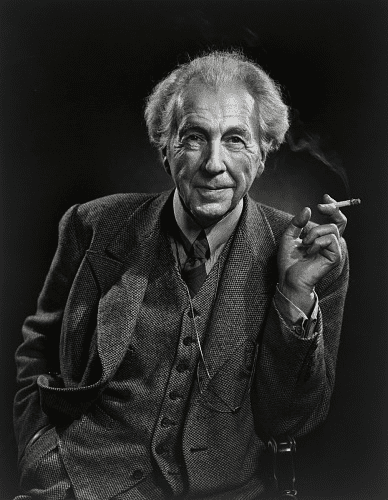
It is not surprising that he perceived architecture not as a craft, but as a moral act. He once expressed it this way:
“The creation of a good building, a harmonious structure, adapted to its purpose and to life, is a blessing to life, a noble element added to it. It is a great moral accomplishment.”
However, moral accomplishments face continuous difficulties in the conditions of Manhattan. When surrounded by concrete and glass facades, and square meters are worth their weight in gold – it is difficult to remain faithful to the horizontal, light, and inner peace. Yet Wright still tried. Twice. And both times he did it his own way.
From Prairies to Metropolis: The Transformation of Wright’s Architecture
At the start of his career, Frank Lloyd Wright primarily built private homes – low, sprawling, with long eaves and smooth transitions between rooms. They were called “prairie houses” – not because of romance, but because of their connection to the landscape. This was architecture that did not seek a stage but merged with the site, adhered to the horizontal, and was not afraid of “emptiness.”
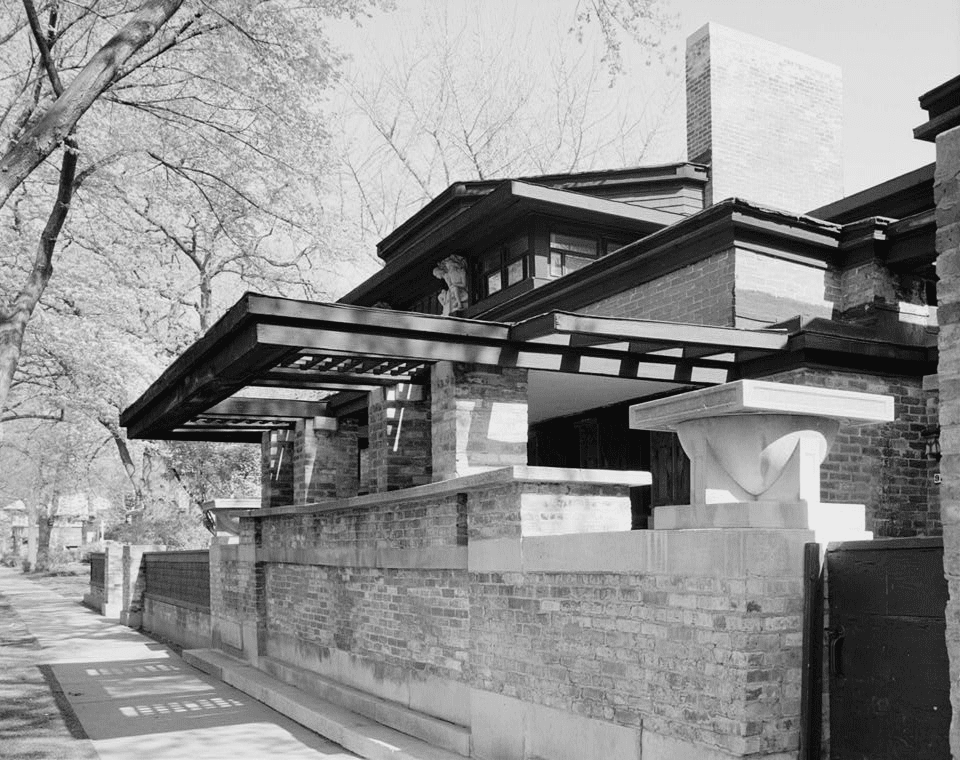
But the further he went, the more interesting it became. Starting in the 1930s, Wright discovered concrete, new structures, and helical forms. More plasticity appeared in his works, and volumes began to “move.” The architect seemed to challenge right angles and tried to speak in a curved line. Not like the Flatiron, but in his own style. And the main thing was not the decor, but movement, logic, and atmosphere.
And here the question arises: what about Manhattan? A city of squares, street grids, and vertical intrusiveness. Everything Wright avoided for decades is gathered in one borough. But instead of blending into the surrounding rhythm, he took another path – creating a counter-rhythm. This is how the objects that do not adapt to Manhattan, but enter into a dialogue with it, came into being.
The most radical of these was the Guggenheim Museum – a monolithic structure with a spiraling ramp, coiling like a shell in the center of the metropolis. But the second project – the car showroom – also held its own significance. Where everyone thought linearly, Wright allowed himself a curve. Where others counted square meters, he counted sensations.
Wright’s Structures in Manhattan
Wright’s architecture usually gravitates toward nature, space, and quietness. Everything that Manhattan is not. But perhaps this is what made his appearance in the center of New York so noticeable. Only two realized projects – and both became a kind of antithesis to everything that was around. There were no attempts to “fit in.” There was a desire to influence. Wright seemed to declare: here I am, here is my geometry, here is my idea – try to ignore it.
And he did not get lost against the backdrop of Manhattan skyscrapers. The Guggenheim still troubles critics and tourists, and the car showroom – although lost in space – remained in history as a lesson: even commerce can have architectural charm if Wright designs it.
Solomon R. Guggenheim Museum (1959)
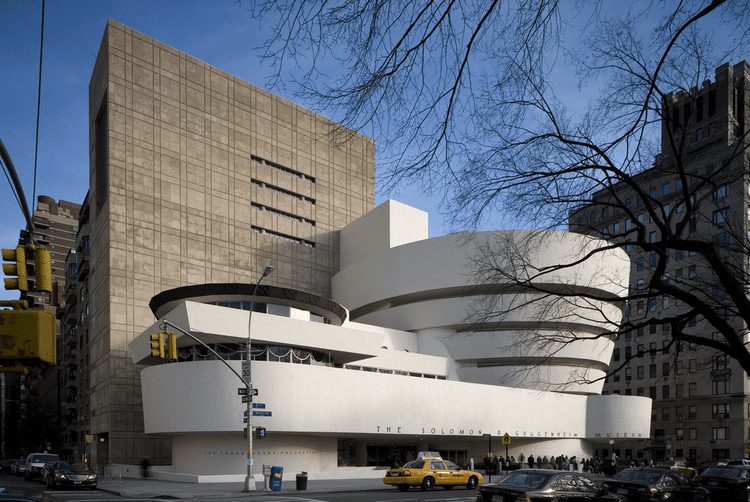
You cannot mistake this building for anything else. It stands on Fifth Avenue – amidst the classic urban rhythm – and looks as if it was accidentally teleported from another universe. The Guggenheim is a concrete spiral that grows out of the ground and coils into the sky. In a city where everything is straight, Wright created a helix.
During the construction phase, almost everyone criticized the project: artists – for the “inconvenience” of the exhibitions, citizens – for the strange shape, architects – for the rebellion against the urban context. But decades passed – and the museum turned into an architectural symbol of New York. Tourists go there not only for art, but also for the site itself – it truly works on emotion.
The irony is that Wright himself did not even live to see the opening. The museum was completed after his death. But this is not an ordinary monument, but proof that bright ideas can overcome skepticism.
Hoffman Auto Showroom (1954–1955)
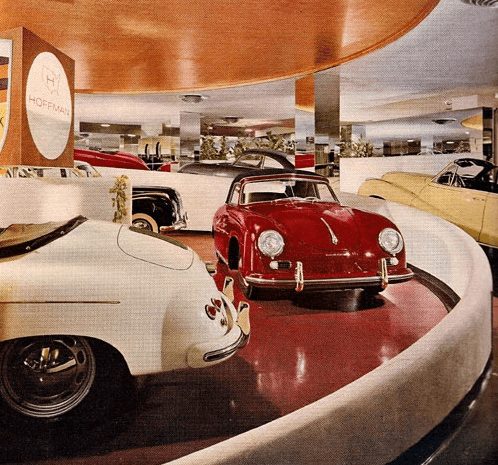
A much less known, but no less interesting project – the car showroom for luxury car importer Max Hoffman. It was located on Park Avenue, inside an office building, and this alone forced Wright to think outside the box.
He created something between a gallery and a stage: a glass display window, a curved wall, a whimsical arrangement of lights – all this made the cars the main protagonists of the space. Movement within the premises was thought out in detail, almost like dancers.
Unfortunately, the car showroom no longer exists – it was dismantled. But some parts are stored at MoMA as exhibits. And, let’s agree, not every car showroom can boast this.
What Remained Unbuilt – Projects Left on the Drawings
Wright had a few more ambitions for Manhattan. For example, in the 1940s, he proposed a project for an opera house that was supposed to be nothing less than an architectural revolution. But the work did not go further than the drawings – his ideas seemed too bold to the clients.
This is a typical plot for Wright: not all of his projects withstood the collision with reality. However, those that were realized remained in the urban landscape as a provocation – against banality, against boring symmetry, against architectural templates.
Why It Still Works
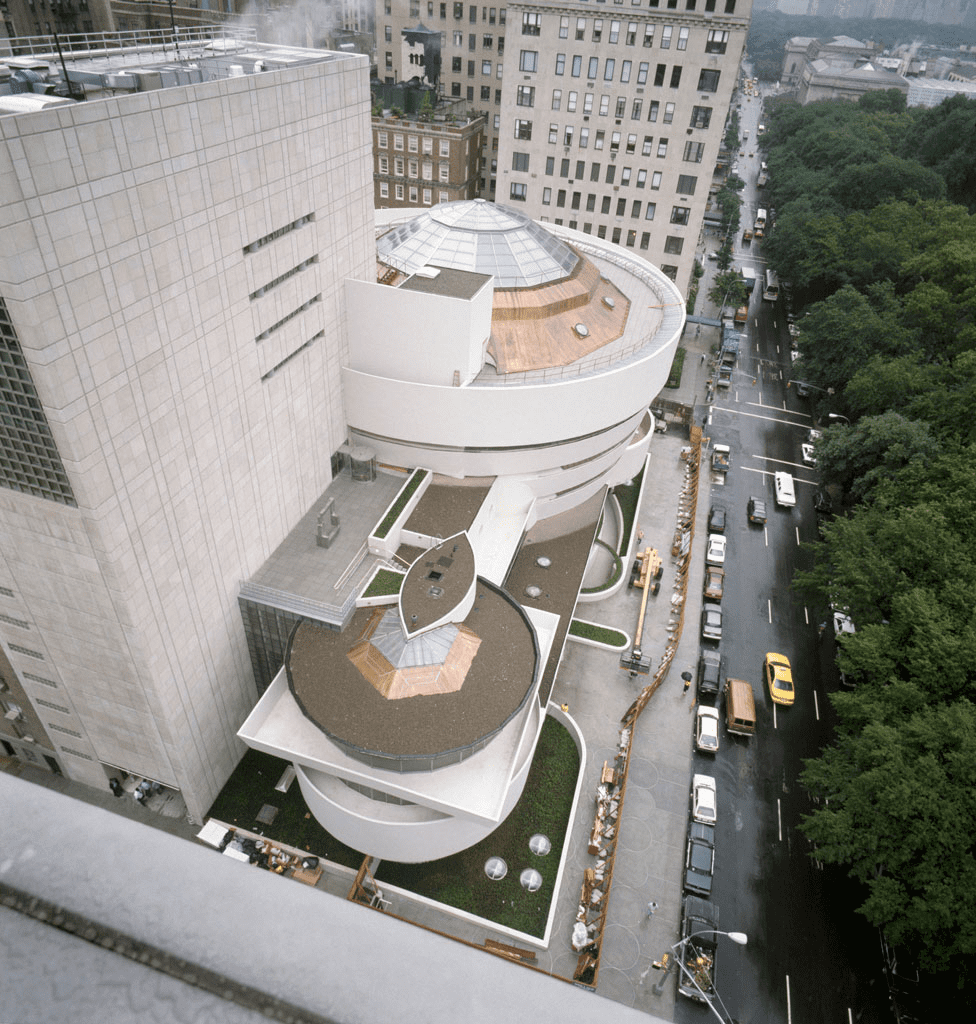
The Guggenheim Museum has long ceased to serve merely as a place for paintings. It has become a de facto tradition, a ritual. You walk along that spiral – the walls are silent, and the space seems to breathe a concrete wave. Everything here works on sensation: how you move, what you see, how you perceive. And although the exhibition may be different, the museum always leaves an impression. Sometimes you won’t recall a single work, but you remember what you felt while viewing them.
Wright was ahead of many of his colleagues. His approach – where form is dictated by an idea, not by budget or fashion – subsequently became a guideline for a whole generation of architects. He showed that even in a city that leaves no chance for the horizontal and silence, one can create a territory where man once again becomes the center.
And perhaps the most important thing is the attitude. For Wright, architecture was not a backdrop for life or a tool for making money. It was an ethical endeavor. His buildings truly add something. They do not merely fit in; they converse. And it seems that even concrete Manhattan has nothing against it.

